We can't find the internet
Attempting to reconnect
Something went wrong!
Hang in there while we get back on track
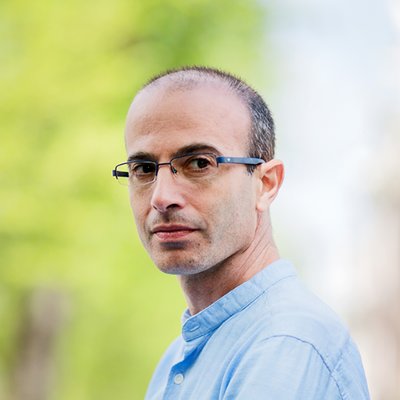 Yuval Noah Harari


I am this person!
 Delegate
Choose a list of delegates
to vote as the majority of them.
Unless you vote directly.
Israeli historian and professor at the Hebrew University of Jerusalem
I am this person!
Location: Israel
ai-governance (4)
ai-regulation (4)
ai-safety (4)
policy (4)
ai-ethics (3)
ai-policy (3)
future (3)
agi (2)
ai (2)
ethics (2)
existential-risk (2)
economics (1)
future-of-work (1)
impact-on-labor (1)
inequality (1)
Top
New
-
Yuval Noah Harari
votes Against
and says:
Berkeley-based non-profit Palisade Research published a study showing the lengths that advanced AI models will often go to achieve their goals. While playing against a powerful chess engine, models from both OpenAI and China's DeepSeek frequently dec...
more AI Verified source (Jun 8, 2026) 1 of 4
 added 3mo ago
-
Pausing AI at human-genius level to solve alignment is safer than either racing to superintelligence or halting entirely
114 opinions
Yuval Noah Harari
votes For
and says:
Superintelligence would likely break the very operating system of human civilization – and is completely unnecessary. If we instead focus on building controllable AI tools to help real people today, we can far more reliably and safely realize AI’s in...
more AI Verified source (Mar 27, 2026)
added 2mo ago
-
Yuval Noah Harari
votes For
and says:
Superintelligence would likely break the very operating system of human civilization – and is completely unnecessary. If we instead focus on building controllable AI tools to help real people today, we can far more reliably and safely realize AI’s in...
more AI Verified source (Mar 27, 2026)
added 2mo ago
-
Yuval Noah Harari
votes For
and says:
[…] there is enormous positive potential otherwise we wouldn’t develop it. AI can invent new medicines. Uh, you can have AI doctors providing billions of people around the world with much, much better healthcare than what people receive today. I’m n...
more Unverifiable source (2024)
added 11mo ago
-
Yuval Noah Harari
votes For
and says:
It was not powerful enough to destroy humanity. AI is. If religious wars resume [...] with AI and nuclear bombs, I don't think humanity would survive.
AI Verified source (May 11, 2023) 1 of 3
added 7mo ago
-
Yuval Noah Harari
abstains
and says:
Paying people not to work will only increase inequality and rancor. [...] If universal basic income is aimed to improve the objective conditions of the average person in 2050, it has a fair chance of succeeding. But if it is aimed to make people subj...
more AI Verified source (2017)
added 2y ago
Other authors to follow
 OpenAI
AI research organization
OpenAI
AI research organization
 Dario Amodei
CEO at Anthropic
Dario Amodei
CEO at Anthropic
 Anthropic
AI safety research company
Anthropic
AI safety research company
 Sam Altman
CEO at OpenAI
Sam Altman
CEO at OpenAI
 Yoshua Bengio
AI Pioneer, Turing Award winner
Yoshua Bengio
AI Pioneer, Turing Award winner
 Demis Hassabis
Nobel laureate, AI Researcher and CEO of DeepMind
Demis Hassabis
Nobel laureate, AI Researcher and CEO of DeepMind
 António Guterres
UN Secretary-General
António Guterres
UN Secretary-General
 Bernie Sanders
U.S. Senator from Vermont
Bernie Sanders
U.S. Senator from Vermont
 Geoffrey Hinton
Godfather of Deep Learning
Geoffrey Hinton
Godfather of Deep Learning